Florida’s tiny home movement isn’t just about minimalism, it’s about affordability, hurricane resilience, and living where your backyard is the beach. With housing costs climbing and people rethinking square footage after years of remote work, tiny home communities are popping up from the Panhandle to the Keys. But this isn’t parking an RV in your cousin’s driveway. These are purpose-built neighborhoods with shared amenities, clear zoning compliance, and residents who’ve made the permanent shift to smaller footprints. Whether someone’s a retiree downsizing or a young professional chasing flexibility, Florida’s climate and regulations make it one of the better states to try tiny living, if the buyer does the assignments first.
Table of Contents
ToggleKey Takeaways
- Florida tiny home communities offer substantial cost savings—both upfront and ongoing—compared to traditional homeownership, making them ideal for retirees and young professionals seeking affordable housing.
- Zoning laws for tiny homes vary by county and municipality in Florida; always verify legal status, permits, and building compliance with your local planning department before purchasing land or joining a community.
- Climate-appropriate design is critical for Florida tiny homes, requiring closed-cell spray foam insulation, mini-split HVAC systems, hurricane-resistant construction, and moisture management to withstand heat, humidity, and storms.
- Tiny home communities provide built-in social amenities and shared spaces that reduce maintenance burden, but potential buyers should spend time in a rental unit first to confirm the lifestyle is the right fit.
- Financing tiny homes is challenging with conventional lenders; most buyers pay cash, use personal loans, or work with specialty lenders, so factor this into your financial planning.
- Resale value and long-term market stability for tiny homes remain uncertain, especially for tiny homes on wheels, which can take months to sell and may face insurance and hurricane vulnerability issues.
What Are Tiny Home Communities and Why Florida?
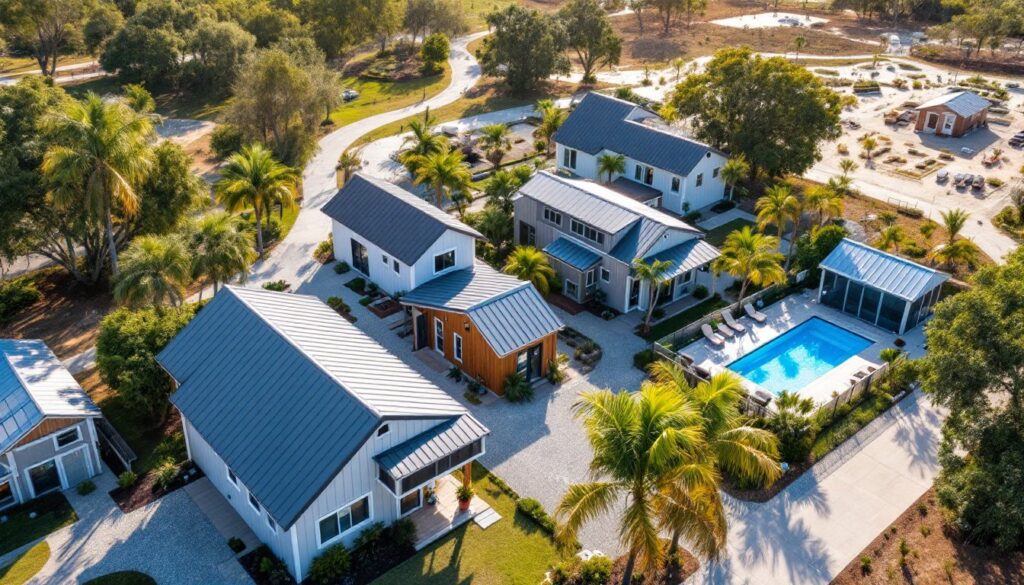
Tiny home communities are planned residential developments designed specifically for homes under 400 square feet (though some allow up to 600). Unlike scattered ADUs or backyard cottages, these communities offer dedicated plots, utilities hookups, and often shared spaces like clubhouses, gardens, or dog parks. Think of them as small-lot subdivisions, but instead of 2,000-square-foot colonials, residents live in compact structures, some on wheels (THOWs, or Tiny Homes on Wheels), others on permanent foundations.
Florida’s appeal is threefold: year-round weather, lower cost of living compared to coastal California or the Northeast, and a regulatory environment that’s warming up to alternative housing. Retirees find the smaller footprint manageable. Remote workers value mobility (some THOWs can be relocated if job or lifestyle shifts). And the state’s growing population has pushed municipalities to explore creative housing solutions. Counties like Pinellas and cities in the Tampa Bay area have begun carving out zoning for tiny home parks, especially as workforce housing becomes critical.
The climate matters too. Florida’s heat and humidity demand robust insulation, proper HVAC sizing, and moisture-resistant materials, all challenges that tiny home builders have adapted to with spray foam insulation, mini-split AC units, and metal roofing that sheds rain fast.
Legal Considerations and Zoning Laws for Tiny Homes in Florida
Florida doesn’t have a statewide tiny home code. Zoning and building regulations are handled at the county and municipal level, which means rules in Orlando differ from those in Fort Myers or Gainesville. The first question: Is the home on a permanent foundation or on wheels?
Foundation-built tiny homes (under 600 square feet) are generally treated as accessory dwelling units (ADUs) or single-family residences if they meet local building codes. They must comply with the Florida Building Code (FBC), which adopts the International Residential Code (IRC) with state-specific amendments. That means engineered drawings, permits, inspections, and compliance with wind-load requirements (especially in hurricane zones). Setbacks, minimum square footage rules, and lot coverage ratios all apply, some municipalities still enforce outdated minimums (like 700 square feet), effectively banning tiny homes unless a variance is granted.
Tiny homes on wheels (THOWs) occupy a gray area. If classified as an RV (built to RVIA or NFPA 1192 standards), they can be parked in RV parks but not used as permanent residences in most residential zones. If built to IRC standards with a permanent chassis, some jurisdictions treat them as mobile homes, which may require placement in a manufactured home community.
Tiny home communities sidestep much of this by operating as planned developments or RV resorts with special-use permits. Prospective residents should confirm the community’s legal status with the local planning department. Some operate in compliance with county codes: others exist in enforcement limbo. Always verify that utilities (water, sewer, electric) are permitted and that the community isn’t at risk of being shut down. If buying land independently, hiring a local contractor familiar with zoning can save months of headaches.
Top Florida Tiny Home Communities to Consider in 2026
As of 2026, Florida has a handful of established tiny home communities and several in development. Here are standouts worth researching:
The Oaks at Spring Lake (Sebring): One of Florida’s first fully tiny-home neighborhoods, featuring individually owned lots (not rentals). Homes range from 300 to 600 square feet on foundations. Community amenities include a clubhouse, pool, and walking trails. Lot prices start around $35,000: turnkey homes begin near $100,000.
ESCAPE Tiny Home Village – The Oaks (Tampa Bay area): Developed by ESCAPE, a national tiny home builder, this community offers ready-made units starting at $100,000 for homes under 400 square feet. It’s a mix of purchase and rent-to-own options. The location appeals to professionals commuting to Tampa or St. Pete.
Orlando Lakefront (Orlando): A newer concept combining tiny homes with glamping-style short-term rentals. Some units are owner-occupied year-round: others generate rental income. Zoning here leans on the resort model, so check whether full-time residency is allowed before committing.
Tiny Estates (various locations): A network of tiny home parks across Florida, including sites near Clearwater and Fort Lauderdale. Most accept THOWs and offer month-to-month or annual leases. Utilities are individually metered. Rules vary by site, so confirm pet policies, guest rules, and whether the site is classified as an RV park.
Before touring, ask about HOA fees, whether the land is owned or leased, and what building standards apply if bringing your own tiny home. Some communities require certification from NOAH (National Organization of Alternative Housing) or compliance with Florida’s wind codes.
Cost Breakdown: What to Expect When Joining a Tiny Home Community
Tiny living is cheaper than a conventional mortgage, but it’s not free. Costs break down into land, structure, utilities, and ongoing fees.
Land/Lot Purchase or Lease: If buying a lot outright (like at The Oaks), expect $30,000–$60,000 depending on location and amenities. Leased lots in RV-style parks run $400–$800/month. Leasing offers flexibility but no equity. Buying builds ownership but locks the resident into that community.
Tiny Home Purchase or Build: A turnkey unit from a builder like ESCAPE, Tumbleweed, or a regional fabricator costs $60,000–$150,000 for a 200–400 square foot home with mid-grade finishes. DIY builds can cut that in half but require significant skill, framing, electrical, plumbing, insulation, and finish carpentry. Permitting a DIY build (if on a foundation) adds engineer stamping fees, plan review, and inspection costs, typically $2,000–$5,000.
Site Prep and Utilities: Connecting to community water, sewer, and electric costs $3,000–$10,000 if not included in the lot price. THOW residents using RV-style hookups pay less upfront but may face higher monthly fees.
Ongoing Costs: Monthly HOA or community fees range from $150–$400, covering road maintenance, trash, landscaping, and shared amenities. Property taxes on tiny homes are lower, often $500–$1,500/year depending on assessed value and county. Homeowners insurance for a tiny home runs $400–$800 annually: THOW owners may need specialty RV or mobile home policies.
Total first-year outlay (buying lot + turnkey home + hookups + fees) can hit $100,000–$200,000. Compare that to a $300,000 median Florida home with higher property taxes, utilities, and maintenance, and the savings become clear, especially for retirees on fixed incomes.
Designing Your Florida Tiny Home for Climate and Lifestyle
Florida’s heat, humidity, hurricanes, and afternoon thunderstorms demand specific design choices. A tiny home built for Oregon won’t survive a Panhandle summer or a Cat 3 storm.
Insulation and HVAC: Closed-cell spray foam insulation is the gold standard, it resists moisture, seals air leaks, and provides an R-value of 6–7 per inch. Mini-split heat pumps (1–1.5 ton) are efficient for spaces under 400 square feet, offering both cooling and heating. Undersized units will run continuously and fail early: oversized ones cycle too fast and don’t dehumidify properly. Install a separate dehumidifier if indoor humidity creeps above 55%.
Hurricane Resistance: Homes on permanent foundations should be engineered for 140+ mph wind loads (per FBC for Wind Zone III or IV). That means hurricane straps, impact-resistant windows or shutters, and metal roofing with standing seams secured every 12 inches. THOWs are more vulnerable: some communities require residents to evacuate or stabilize units with ground anchors and tie-downs rated for manufactured homes.
Moisture Management: Use pressure-treated lumber or galvanized steel framing at the base. Vinyl or fiber cement siding outlasts wood in humid climates. Interior finishes should avoid porous drywall in wet areas, consider cement board with waterproof paint in bathrooms. Install exhaust fans vented to the exterior (not into attics) to prevent mold.
Outdoor Living: With year-round usable weather, a covered porch or lanai extends usable space without adding square footage. Screened enclosures keep bugs out. Consider awnings over south- and west-facing windows to cut solar gain and AC costs.
Storage: Tiny living demands creative storage. Built-in cabinetry, lofted sleeping areas, and furniture with hidden compartments are standard. For ideas on maximizing small interiors, design resources focused on compact spaces offer countless strategies that translate well to tiny homes.
Water and Electrical: Most tiny homes use standard 100-amp electrical service. If off-grid, size solar arrays for AC loads, expect 3–5 kW of panels minimum. Rainwater collection is legal in Florida and can supplement irrigation, though potable water typically comes from community hookups.
Pros and Cons of Tiny Home Community Living in Florida
Pros:
• Lower housing costs: Both upfront and ongoing expenses are a fraction of traditional homeownership.
• Community and amenities: Shared spaces, social events, and neighbors who’ve chosen the same lifestyle create built-in camaraderie.
• Reduced maintenance: Less square footage means less to clean, repair, and replace.
• Mobility (for THOWs): If life changes, some residents can hitch up and move to a new community or state.
• Environmental footprint: Smaller energy use, fewer materials, and often more mindful consumption.
Cons:
• Space limitations: Storage, guests, and hobbies that require room (woodworking, large collections) become difficult.
• Resale uncertainty: The tiny home resale market is still developing. Selling a THOW can take months: foundation homes may appraise oddly.
• Zoning and legal risks: Communities operating without full permits can face shutdowns. Always verify legal status.
• Financing challenges: Most conventional lenders won’t finance tiny homes. Buyers often pay cash, use personal loans, or work with specialty lenders at higher interest rates.
• HOA restrictions: Community rules can be strict, exterior paint colors, parking, pets, and even guest stays may be regulated.
• Hurricane vulnerability (THOWs): Homes on wheels are less secure in severe weather. Some insurance policies exclude named-storm damage.
Anyone considering tiny living should spend a trial period in a rental unit or Airbnb to gauge whether the lifestyle fits before committing capital.
Conclusion
Florida’s tiny home communities offer a viable path to affordable, low-maintenance living in a state with year-round sunshine and evolving housing needs. Success depends on thorough research, zoning compliance, community reputation, climate-appropriate design, and honest assessment of lifestyle fit. Those willing to downsize square footage without sacrificing quality of life will find a growing network of communities ready to welcome them.